Three days in Seville and why going alone is entirely the point
Seville does not make solitude feel like a condition. That is not a given in European cities – plenty of places make the single traveller feel like a logistical anomaly, an awkward body to be accommodated at the corner table, the one the waiter looks past when scanning the room for someone worth attending to. Seville is different. It is a city that eats and drinks collectively, at bars and markets and terrace tables, and that culture means arriving alone and finding a stool, ordering a caña, watching the room – this is not conspicuous. It is, in fact, precisely what everyone else is doing.
Three days is enough to understand what Seville is. Not to exhaust it – that would take longer and would miss the point. But three days, anchored in Triana, moving unhurriedly between the old town and the river, eating and drinking well: that is enough to feel that the city has offered itself to you rather than merely presented itself for inspection.
Day one: get your bearings, then lose them
Resist the temptation to do too much on the day you arrive. Seville takes time to settle into, and the instinct to cover ground quickly is the wrong one. The best use of a first morning is a walking tour of the old city – one that includes the Cathedral and the Real Alcázar as part of its itinerary. Both are unmissable in the genuinely earned sense of that word, but the detail matters: the Alcázar’s queues can be punishing if you arrive alone with a standard ticket. A walking tour that includes entry solves this entirely, adds a guide who can explain the layered Moorish and Christian history, and gives you the context you need to understand the rest of the city.
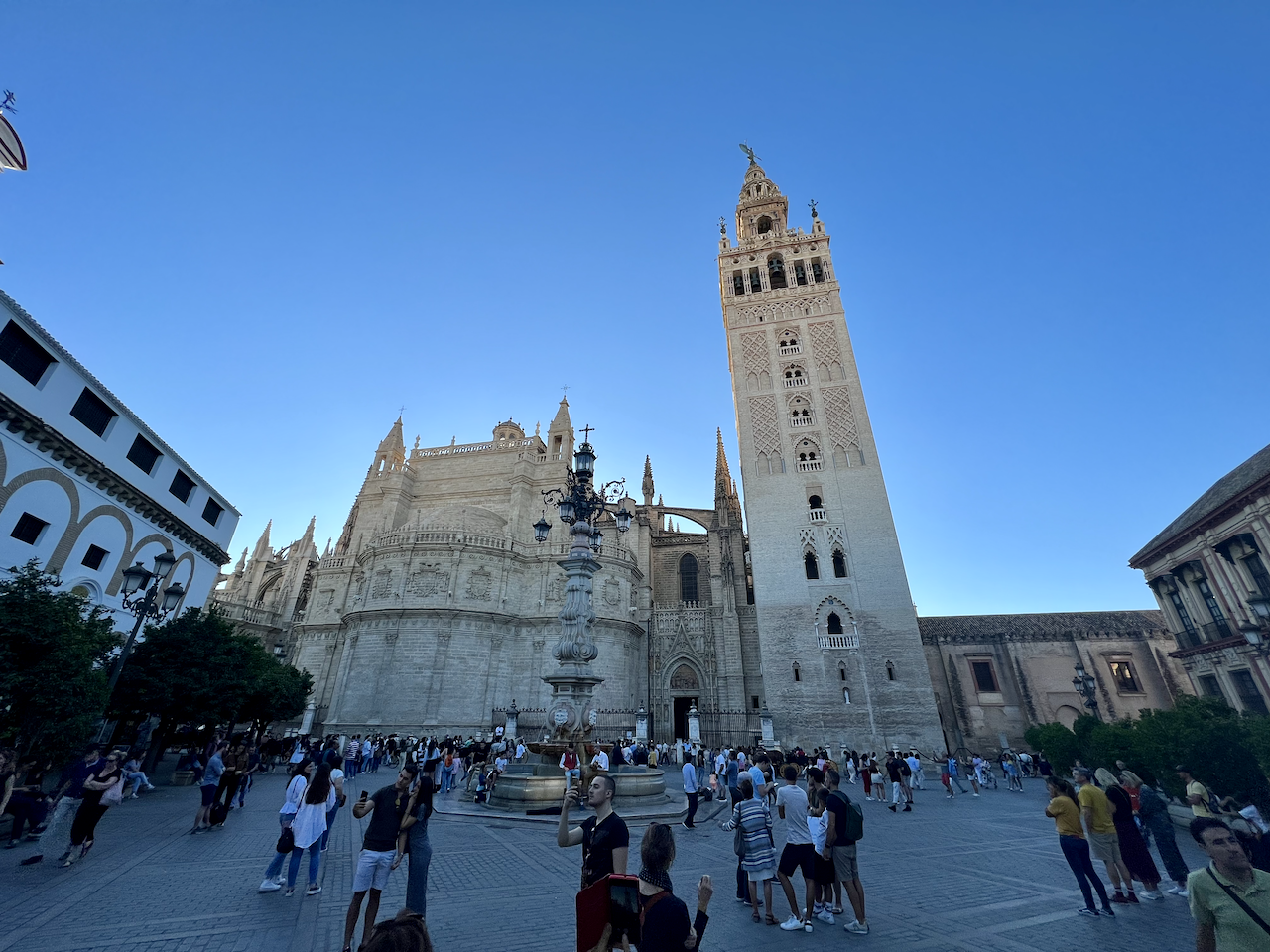
The Cathedral and Giralda
The Cathedral is worth a separate note. La Giralda – the soaring minaret later crowned with a Renaissance bell tower – is the building that anchors Seville visually, and climbing to the top is worth the extra ticket. The views over the old city are among the best in the south of Spain. Alternatively, arrive for morning mass, which is free to attend and a remarkable experience in itself in a nave of this scale.
After the tour, cross the river. The Puente de Isabel II takes you from the old town into Triana, and the moment you arrive on the other side, the temperature of the city changes – fewer tourists, more life. Calle San Jacinto runs straight ahead; follow it, find a bar, order a cerveza, and let the afternoon go where it goes. Triana is where you should be based for the weekend, and an afternoon of aimless walking is the correct way to understand why.
The evening belongs to the Alameda de Hércules. This long, tree-lined boulevard in the Macarena district – a 15-minute walk north of the Cathedral – is where Seville actually gathers. Families, students, older couples, dogs, children on bicycles: the whole city at its most unhurried. The bars lining both sides fill from early evening and the terrace tables spill onto the boulevard. Find one. Order a cold beer. Watch the city live its life.
Day two: the market, the palace, the oldest bar
The centrepiece of any food-led visit to Seville is the Mercado de Triana, and the centrepiece of the Mercado de Triana is any of the bars at the back of the market. But before heading for the market, start the morning at Coffee Up Triana first – a small, owner-run café close to the market where a New Yorker called Justin has been roasting and brewing single-origin coffee to a standard that most of the city has not caught up with. The offer changes daily: one morning it might be a Brazilian with bitter depth and a trailing sweetness; another day something lighter and more floral. The space is small and unhurried, the atmosphere quiet without being self-conscious about it. It is a near-perfect morning base for a solo visitor: independent, personal, and with enough going on – good coffee, a knowledgeable owner, the Triana streets outside – that starting the day alone here feels like a choice rather than a default.
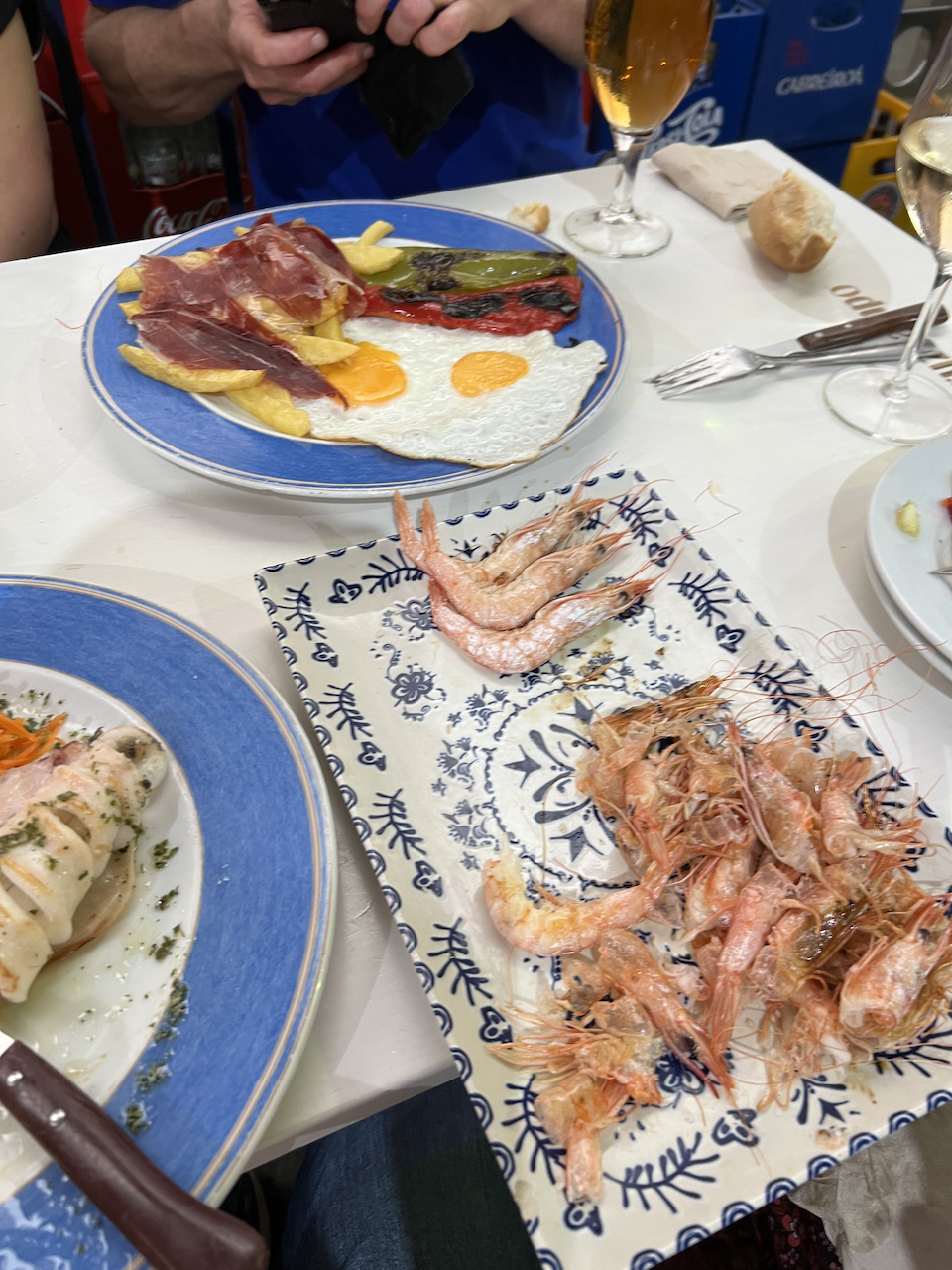
Freshly grilled gambas from the Triana market (or huevos rotos for those who don’t like seafood)
Then the market. Go late morning, around 11am, when the stalls are at their liveliest and the bars are beginning to fill. Walk through the market itself first – the produce, the fish, the colour of it – and then make for the inner perimeter, where a row of small bars lines the back wall. Pull up a stool, order a glass of verdejo, and pick your fish: prawns, squid, or whatever looks freshest that morning. They grill it simply – olive oil, parsley, salt, nothing more – and the result is one of those dishes so straightforward and so good that it stops you in your tracks. This is how Seville actually eats.
The afternoon is for Casa de Pilatos. While everyone queues for the Alcázar, a ten-minute walk away sits one of the most beautiful buildings in Spain, largely to itself. The private palace of the Dukes of Medinaceli – which it still is, in part – is a succession of patios, Moorish tilework, fountains, and Roman sculpture, each space leading into the next with an unhurried intimacy that the Alcázar cannot offer at peak season. The ground floor is open without a guide. The upper floor requires a timed tour and is worth every euro. This is not a heritage site in aspic. It is a house with five hundred years of use still visible in its walls.
El Rinconcillo in the early evening. The oldest bar in Seville, open since 1670, and the crucial detail is that it has not traded on its age. The bar works exactly as it always has: order a caña or a glass of fino, and a small tapa will arrive without asking – espinacas con garbanzos, perhaps, the Sevillano classic of spinach and chickpeas that is quieter and more perfect than it sounds. Your bill is chalked on the wooden counter in front of you. The interior – dark wood, azulejo tiles, barrels stacked to the ceiling – is the real thing. Arrive by 7pm. It fills fast.
The evening ends at Casa de la Memoria. This 15th-century palace in Santa Cruz hosts nightly flamenco in a courtyard holding fewer than a hundred people, and at that scale there is nowhere to hide – for the performers or the audience. The guitar, the voice, the footwork: you feel the percussion through the stone floor. Book well in advance. This is not a casual evening out. It is the correct way to understand why flamenco matters.
Day three: the park, the view, and a counter seat in Triana
The Plaza de España deserves a morning. Built for the 1929 Ibero-American Exposition, the sweeping semicircular pavilion decorated with painted ceramic tiles representing every province of Spain is one of the most beautiful public spaces in the country, and the surrounding Parque de María Luisa is something stranger and better – dense with South American plants and trees, it has an almost tropical feel entirely out of keeping with the rest of the city. Flamenco dancers often perform spontaneously in the shade of the pavilion: one of those Seville moments that is impossible to stage and impossible to forget. On a hot Seville day, the shade the park provides is not just pleasant – it is essential.

The Metropol Parasol (nicknamed ‘Las Setas’)
At dusk, Las Setas. The Metropol Parasol – the vast wooden mushroom structure that opened in 2011 and divided Sevillanos at the time, many of whom still have mixed feelings about it sitting in the old city – has a rooftop walkway that delivers the best 360-degree panorama of Seville available anywhere. The Cathedral to the south, the Macarena quarter to the north, the Guadalquivir in the distance, the old city turning the colour of warm bread as the light drops. Entry is around €5 and includes a drink at the bar on top. Go at this hour on the last evening and you will understand why people return to Seville.
Dinner at Eslava, on Calle San Jacinto in Triana. This is a restaurant with a serious reputation for creative Andalusian cooking – traditional ingredients handled with precision, without the performative flourishes of fine dining – and it fills quickly. The bar counter is what makes it right for a solo evening: you can arrive without a reservation, take a stool, watch the kitchen, and order as much or as little as you want without the mild pressure of a table for one in a busy room. The slow-cooked egg with mushroom and truffle is the dish people mention most, and with good reason. The neighbourhood outside is a proper Triana street, and an evening that begins here can extend naturally into a walk along the river, or a quiet glass somewhere nearby. It is not a destination that asks anything of you except attention to what is on the plate.
A note on travelling alone here
Seville does not require you to perform sociability. The bar culture, the stool, the counter, is a structure that absorbs a solo traveller without making them the subject of attention. By the third evening you will have eaten better, moved more freely, and seen more of the real city than you would have managing another person’s priorities alongside your own. That is what Seville offers a solo traveller who pays attention to food. It is quite a lot.